

Qualitative Research Methods
Qualitative research is widely used, yet there are limited options to learn about and through doing qualitative research. The purpose of this course is to develop knowledge and skills to critically assess, design, conduct, analyze, and share qualitative research.
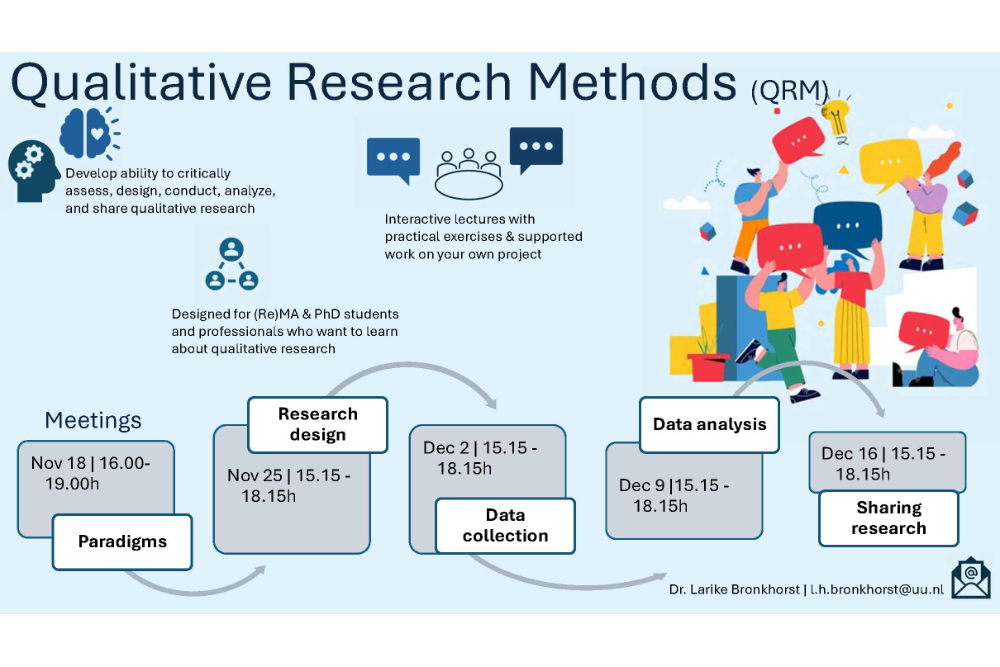
The course (5 EC) starts with an exploration of the theoretical principles underlying qualitative approaches and subsequently explores the different phases of the research process; from generation of a research question, to data collection, analysis and the sharing the findings with different audiences.
The course combines theoretical lectures by experts in the field with practical exercises and hand-on work on your own research project. The course is open to (Re)MA and PhD students and professionals who aim to conduct qualitative research independently and confidently, after completing the course.
We also offer a so-called ‘lean’ option, in which you take part in the interactive lectures but do not work on your own project (equivalent to 2EC)
Across domains, some perennial questions benefit from an in-depth approach, for example, what are the mechanisms contributing to the situation at hand? And: how do different stakeholders experience this situation? Being able to conduct qualitative research enables you to address these questions systematically.
What's in it for me?
- Increasing your understanding of qualitative research enables you to identify ways of answering these questions systematically.
- Learning about and practicing qualitative data collection techniques (e.g., interviews) and qualitative analysis, this course walks through the whole research cycle.
- Lecturers bring in their ongoing qualitative work, and particpants are encouraged to do so as well.
For whom?
The course is open to (Re)MA and PhD students and professionals who aim to conduct qualitative research independently and confidently, after completing the course. No prior knowledge is expected. Lectures are interactive, and suitable to different levels by having participants prepare questions and do assignments in small groups. Support for independent qualitative research conducted throughout the course is tailored to learning needs.
Expected Time Investment
Preparing for seminars (reading literature, preparing questions) | 25 hours |
Preparing for small group work sessions (incl. individual reflections) | 25 hours |
Attending seminars (5 x 2hrs) and supervised work on research (5 x 1 hr) | 15 hours |
Own research project | 75 hours |
Total (5 ECTS: 5 x 28 hrs)* | 140 hours |
*We also offer a so-called ‘lean’ option, in which you take part in the interactive lectures but do not work on your own project (equivalent to 2EC).
Time schedule
Date | Subject | Time | Location | Teacher |
November 18 | Paradigms | 16:00 - 19:00 hrs | Martinus J. Langeveld gebouw G225 | Tba |
November 25 | Research Design | 15:15 - 18:15 hrs | Martinus J. Langeveld gebouw G225 | Tba |
December 2 | Data Collection | 15:15 - 18:15 hrs | Marinus Ruppertgebouw 116 | Tba |
December 9 | Data Analysis | 15:15 - 18:15 hrs | Martinus J. Langeveld gebouw G225 | Tba |
December 16 | Sharing Research | 15:15 - 18:15 hrs | Marinus Ruppertgebouw 116 | Tba |
The lecturers at Utrecht University who provide education for professionals combine subject-matter expertise with an open mind. They are actively involved in relevant, current research within their field. They combine academic depth with keen insight into practice, enabling them to thoroughly understand the participants’ lived experiences.
Our lecturers’ excellent teaching skills are specifically tailored to how professionals learn: practice-oriented, interactive, and applicable. Furthermore, value collaboration and create a learning environment where dialogue, knowledge exchange, and co-creation take center stage.
The teacher for this course is:
If you have any further questions regarding the course, please contact:
Sign up for 5 EC course
Sign up for 2 EC course
If you would like to sign up for the 2 EC option of the course, please contact: l.h.bronkhorst@uu.nl